Things are going to get busier as the holidays approach. If I am to share my photos from our time in California, I need to do it now. We spent 3 weeks housesitting for my sister and since my mom also lives nearby, we did things with and for her as well. However, we did fit in some site seeing.
Our first place to visit was the Getty Center in Los Angeles. The museum is free though there is a $15 charge for parking. Special exhibits such as the one we saw on Hellenistic bronzes also have a charge. There is way too much to see in one day. We didn’t even look at the photography galleries nor the decorative arts galleries.
We signed up for the garden tour, but the group was too large and slow moving, the docent’s voice too soft for my husband to hear (I had to strain), and too much time talking about the garden planner and the preparation of the site boring so we broke off and headed into the garden on our own. We wanted to finish before the already hot day became hotter and in time for lunch. You shouldn’t skip walking through the garden. It is very pretty and refreshing.
We really enjoyed our grilled portobello sandwich in the large dining commons. There are several food stations with a variety of options for diners. The big expanse of glass let you see the nearby hills. The Getty Center is perched upon a hill itself; you ride a tram from the parking garages up to the museum complex.
We took my mom to dinner at Mrs. Knott's Chicken Dinner Restaurant . The stewed rhubarb and boysenberry pie were just like I remember. Knott’s Berry Farm has reconfigured the parking for the restaurant and gift shops in recent years. There is no place to pull over and let out a handicapped person (just have to stop in the right lane of traffic), and my mom struggled with her walker over the rough pavers. Not senior friendly, even though we were dining at the early bird senior time and price. We did not go into the amusement park at all.


Our trip to Oak Glen near Yucaipa was probably the most disappointing of our outings. We went on a Saturday and since September is apple harvest time, the place was mobbed out making it hard to find parking and getting scanty service in the restaurant where we ate lunch. The apple cider was tasty but pricey. Of course, the restaurants all served apple pie and strudel. The place felt like a tourist trap, but it did give us a trip east rather than west. My husband was interested to see some desert landscape.


We did brave the traffic-jammed freeways to go west again, though, when we headed for the Getty Villa near Malibu. This should not be confused with the Getty Center which is located inland more. Both are the legacy of J. Paul Getty. For this site, you must make a reservation ahead, even if you are walking in from Pacific Coast Highway. We saw two ladies stopped and turned away at the check-in gate. No museum fee, but again a $15 parking fee, which you do not have to pay if someone lets you off at the bottom of the hill or you use public transit, but you do have to have a reservation.
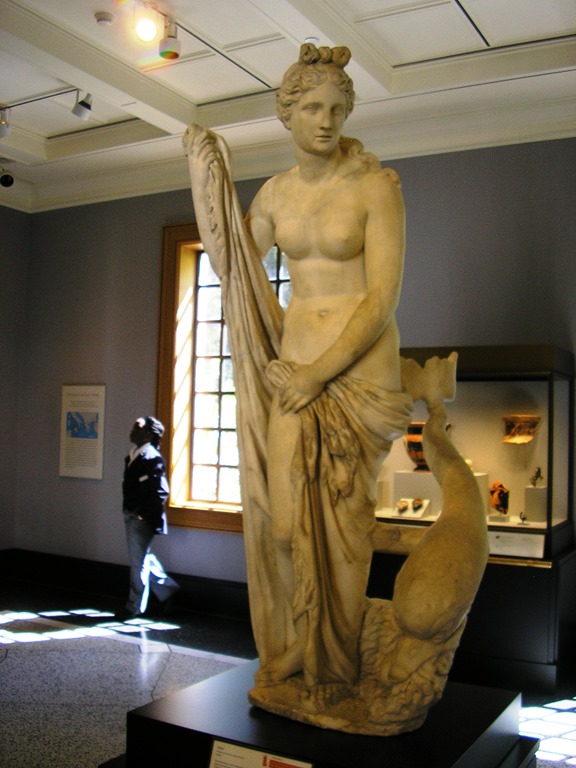
The Villa was created to house Mr. Getty’s Greek and Roman antiquities after his displays outgrew his home which is on the property but not open to the public. The Villa is fashioned after a 1st century Roman country house near Vesuvius. It opened in 1974 but was closed and renovated in 1997, reopening in 2006. The Villa features Roman, Greek, and Etruscan art. An outer and inner peristyle give a Mediterranean feel. There is an outdoor amphitheater where evening performances take place, mostly in the summer. The dining area has a large patio, but the quality and selection of food was subpar and high-priced. We were there on a gorgeous day so enjoyed the ocean breeze and scene, but didn’t enjoy the lunch as we did at the Getty Center. There were many school buses and those children ate in a picnic area, bringing in their own food. Maybe individuals can do that, too. Photography was allowed but inside had to be no flash. Lots of educational signage to read, but even then having some knowledge of mythology was helpful. I wondered about the international visitors, especially those from the Orient, really grasping the displays. The brochures were in at least a dozen languages, but not the signs.


After lunch, we headed south on Pacific Coast Highway through Santa Monica to Venice Beach. From the high culture to the sensationalized tawdry. Lots of body piercings, tats, and exposed skin among those perambulating ocean walk along shops and restaurants. We had delicious ice cream cones while we strolled taking in the suggestive and sometimes lewd t-shirts and bikini bottoms displayed at storefronts, marijuana dispensaries, etc.
It was more wholesome to look towards the ocean waves, cyclists, and skateboarders. We stopped at Muscle Beach where some dudes were working out and offering to pose with tourists, especially female tourists.
Santa Monica in the distance

About the only t-shirts I could share on a family-friendly blog
Southern California certainly isn’t boring.
We went to a big shopping mall in Glendale, then to nearby Griffith Observatory which didn’t open until noon. I was somewhat puzzled when we arrived at 12:15 to see so many cars leaving. How could one see the exhibits in such a short time. The mystery was solved after we finally found a parking spot as a car pulled out. We had to circle the lot several times. People weren’t there for the observatory but to take selfies with the Hollywood sign in the background. The observatory exhibits are mostly free. We paid to see the show in the planetarium which was well worth the small fee. The observatory has some evening hours, and the blood moon eclipse had a special program a few days before we came. Griffith Park has hiking and bridle trails and other museums, but we left around 3 p.m. hoping to beat the rush-hour traffic, but alas any time is jammed up with cars, especially on the Golden State Freeway.


Though my husband uncomplainingly maneuvered the freeways, I wanted something less stressful that we could reach on surface roads. We drove to Fullerton Arboretum as our last outing. This botanical collection adjoins California State University Fullerton where I did my undergraduate work. During my sojourn as a college student this was an undeveloped outer corner of campus with an Orange County homesteader’s residence. Now it has plants from all over the world, specializing in xeriscape choices. Besides the chapparal and desert plants native to California, there were some strange but interesting plants from far away places. We packed a picnic lunch; there are some picnic tables at the entry. The Nature Center was closed when we were there, but maintenance staff answered some questions. One volunteer worker insisted we try a sapote. A pile of them were available. He told us to take it home and let it ripen for about a week. Well, we were visiting on Friday and would be flying home early on Tuesday. He found one that had been eaten into on a small area but was almost ripe. We took it and let it sit out a day or two, finally eating it on Sunday. I cut out the “eaten” part first. This fruit is mostly known in Central and South America. We scooped it out with a spoon, like eating custard. It had a mild pleasant flavor, but not like anything I can describe. It looks kind of like a green apple. The color doesn’t change much as it ripens, but it gets softer like a pear. A few places in California and Florida grow them, but other than farmers’ markets in those states, one isn’t likely to find them for sale.


f you have stuck with me through this long slog, you can see Southern California is not dull. I can never afford to live there again, but having grown up in the state, I will always think of myself as being a Californian no matter where I live.